Still considering buying a new lens? Still need to do mathematical calculations to take the perfect shot?
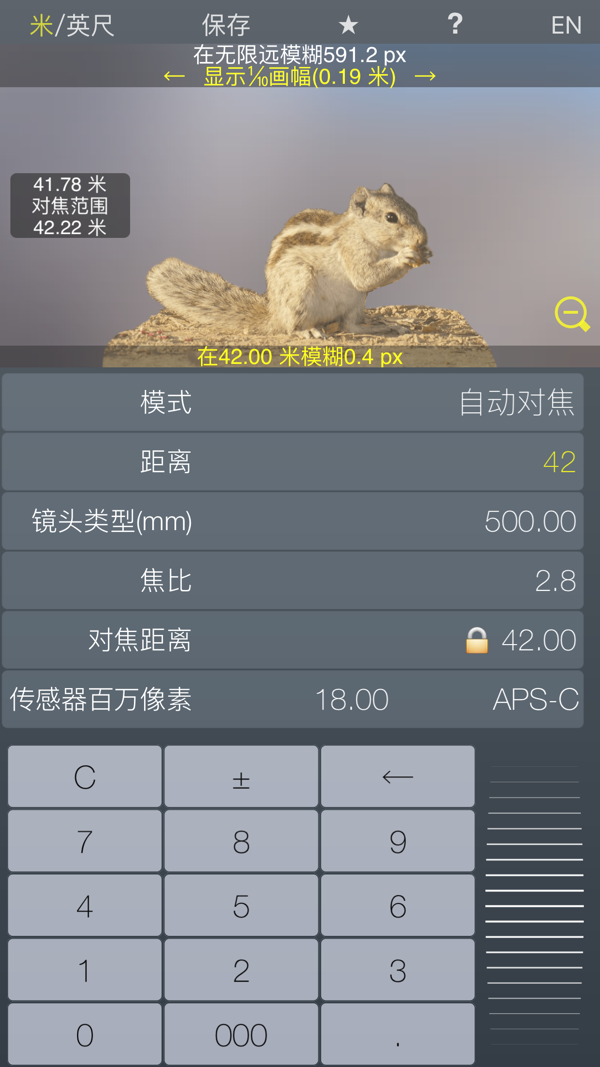
Use this depth of field and circle of confusion calculator to simulate out-of-focus blur. Calculate different camera settings using depth of field and hyperfocal distance, including the diffraction effect of small apertures. Blur values are measured in pixels of the camera sensor. The blur simulation shows the blur level for infinity and the subject, as seen on a 25 cm or 10-inch printout or screen.
Tap the magnifying glass to switch to the full-frame view to evaluate the subject size and switch to the 1/10 frame view to evaluate the blur.
Available parameters are: *Distance* - the distance to the subject, *Lens type* - focal length, *F-ratio* - aperture adjustment, *Focus distance* - the distance at which the lens is focused, *Sensor* - the megapixel count of the matrix and the size of the camera sensor.
You can use the *Hyperfocal* mode to set the focus value for the current F-number to the hyperfocal distance.
If you want both the subject and infinity to be in focus, use the *Auto Hyperfocal* mode, which will find the minimum F and the corresponding focus value. *Auto Hyperfocal* tries to achieve the best possible result, but due to the diffraction effect of small apertures, it may not always get a sharp image, and the simulation will reflect this.
The last smart function is *Max Blur Focus* - given the subject distance and F-number, it wi...


 +100宝石


 分享
分享










用户评价
立即分享产品体验
你的真实体验,为其他用户提供宝贵参考
💎 分享获得宝石
【分享体验 · 获得宝石 · 增加抽奖机会】
将你的产品体验分享给更多人,获得更多宝石奖励!
💎 宝石奖励
每当有用户点击你分享的体验链接并点赞"对我有用",你将获得:
🔗 如何分享
复制下方专属链接,分享到社交媒体、群聊或好友:
💡 小贴士
分享时可以添加你的个人推荐语,让更多人了解这款产品的优点!
示例分享文案:
"推荐一款我最近体验过的应用,界面设计很精美,功能也很实用。有兴趣的朋友可以看看我的详细体验评价~"
关注 Mergeek 公众号
领奖遇到问题?联系小门助手